Key Stories
Vitamin D and Kidney Disease
Kidney disease changes the vitamin D discussion because the kidneys are involved in its processing and in the wider balance of calcium and phosphate. Advice written for generally healthy adults may therefore miss the actual question.
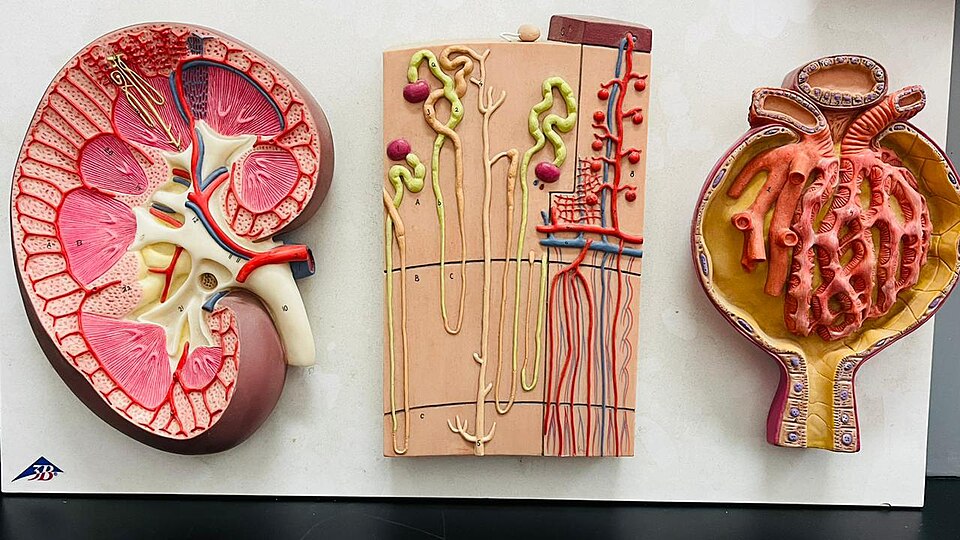

Image details
Illustrative photograph by Rayhana Alhour, Wikimedia Commons. CC0. Image displayed to fit.Kidney disease changes the vitamin D discussion because the kidneys are involved in its processing and in the wider balance of calcium and phosphate. Advice written for generally healthy adults may therefore miss the actual question. It is especially important to know which preparation is being discussed. Similar names on a medicine list can refer to treatments doing different jobs.
Ordinary vitamin D and active preparations differ
Nutritional vitamin D and medicines such as calcitriol are not interchangeable labels for the same treatment. Kidney-care decisions may concern a nutritional shortage, hormone activity or a mineral-and-bone disorder. Those aims need to be identified first. Chronic kidney disease covers different stages and circumstances, including dialysis and transplantation. Calcium, phosphate, parathyroid hormone and other findings can help shape the clinical picture. A vitamin D result should not be interpreted as though the rest were irrelevant.
Use kidney-specific evidence
NICE guidance distinguishes correcting deficiency from considering active preparations in particular advanced-disease circumstances. A European consensus statement also treats nutritional vitamin D in kidney disease as a specific subject, rather than simply importing advice for everyone else. The right question includes kidney function, the preparation and the treatment aim. A generic supplement recommendation cannot replace that context. This topic needs clear explanations of the medicine names and the problem each is intended to address. That is more helpful than presenting all kidney disease as one dosing problem.
Sources
National Institute for Health and Care Excellence. Chronic kidney disease: assessment and management. Accessed 15 November 2026.
The role of nutritional vitamin D in chronic kidney disease-mineral and bone disorder in children and adults with chronic kidney disease, on dialysis, and after kidney transplantation: a European consensus statement
Related reading
The role of nutritional vitamin D in chronic kidney disease-mineral and bone disorder in children and adults with chronic kidney disease, on dialysis, and after kidney transplantation: a European consensus statement
Vitamin D deficiency is common in patients with chronic kidney disease (CKD) and associates with poor outcomes.
Original paper ↗Read more →Effect of nutritional calcium and phosphate loading on calciprotein particle kinetics in adults with normal and impaired kidney function
Plasma approaches metastability with respect to its calcium and phosphate content, with only minor perturbations in ionic activity needed to sustain crystal growth once nucleated.
Original paper ↗Read more →Positive association between serum calcium-phosphorus ratio and kidney stone prevalence: Analysis of NHANES data (2007 to 2020)
This study utilized data from the 2007 to 2020 National Health and Nutrition Examination Survey (NHANES), including a total of 34,122 participants.
Original paper ↗Read more →Positive association between serum calcium-phosphorus ratio and kidney stone prevalence: Analysis of NHANES data (2007 to 2020)
The central objective of this study was to determine whether a significant positive association exists between the serum calcium-phosphorus ratio and the prevalence of kidney stones.
Original paper ↗Read more →Serum phosphate levels modify the impact of parathyroid hormone levels on renal outcomes in kidney transplant recipients
To date, data simultaneously evaluating these parameters and interwoven relations on renal outcomes are scarce.
Original paper ↗Read more →Does transient serum phosphate or serum phosphate status cause chronic kidney disease-associated pruritus in peritoneal dialysis patients? A cross-sectional and group-based trajectory modeling study
We identified the serum phosphate trajectories of PD patients in the last 3 months and investigated the effects of serum phosphate persistence on CKD-aP.
Original paper ↗Read more →Misdiagnosis of chronic kidney disease and parathyroid hormone testing during the past 16 years
Chronic kidney disease (CKD) is a prevalent pathological condition worldwide.
Original paper ↗Read more →Prognosis comparison in chronic kidney disease stages 4 to 5 patients with low parathyroid hormone level due to different causes
This study examines prognostic implications of PTH reduction from different etiologies.
Original paper ↗Read more →A parathyroid hormone/salt-inducible kinase signaling axis controls renal vitamin D activation and organismal calcium homeostasis
The renal actions of parathyroid hormone (PTH) promote 1,25-vitamin D generation; however, the signaling mechanisms that control PTH-dependent vitamin D activation remain unknown.
Original paper ↗Read more →The age-related changes of dietary phosphate responsiveness in plasma 1,25-dihydroxyvitamin D levels and renal Cyp27b1 and Cyp24a1 gene expression is associated with renal α-Klotho gene expression in mice
We found that 1,25-dihydroxyvitamin D levels in plasma were significantly lower in the high phosphate group than the low phosphate group for 1 and 2 month-old mice, but not 13 month-old mice.
Original paper ↗Read more →The dietary management of calcium and phosphate in children with CKD stages 2-5 and on dialysis: clinical practice recommendation from the Pediatric Renal Nutrition Taskforce
Complications of mineral bone disease (MBD) are common and contribute to the high morbidity and mortality seen in children with CKD.
Original paper ↗Read more →Effect of extended hours dialysis on markers of chronic kidney disease-mineral and bone disorder in the ACTIVE Dialysis study
This secondary analysis aimed to determine if changes in associated therapies may have influenced these findings and to identify differences between patient subgroups.
Original paper ↗Read more →Ethnic and seasonal variations in FGF-23 and markers of chronic kidney disease-mineral and bone disorder
We evaluated CKD-BMD markers in a diverse cohort of CKD patients, who were participants of The CANADIAN AIM to PREVENT (the CAN AIM to PREVENT) study.
Original paper ↗Read more →Role of nutritional vitamin D in chronic kidney disease-mineral and bone disorder: A narrative review
Patients with CKD-MBD combined low bone mineral density and fragility fractures are referred to as CKD-MBD with low bone mineral density.
Original paper ↗Read more →Calcitriol induces cell senescence of kidney cancer through JMJD3 mediated histone demethylation
In this study, the biological effect and epigenetic regulation of calcitriol on kidney cancer cells were investigated.
Original paper ↗Read more →Modulation of renal inflammation and tubular injury by calcitriol in patients with early diabetic kidney disease: a randomized controlled trial
This double-blind, randomized controlled trial investigated the effects of calcitriol supplementation on kidney injury biomarkers in patients with early DKD.
Original paper ↗Read more →Persistent changes in calcium-regulating hormones and bone turnover markers in living kidney donors more than 20 years after donation
In our recent survey-based study, we found no increased risk of fractures of all types but observed significantly more vertebral fractures in LKDs compared with matched controls.
Original paper ↗Read more →Phosphate binding by sucroferric oxyhydroxide ameliorates renal injury in the remnant kidney model
Recent clinical studies indicate that the disturbed phosphate metabolism in chronic kidney disease (CKD) may facilitate kidney injury; nonetheless, the causal role of phosphate in CKD progression remains to be elucidated.
Original paper ↗Read more →Regulation of tight junction gene expression in the kidney of calbindin-D9k and/or: D28k knockout mice after consumption of a calcium: or a calcium/vitamin D-deficient diet
Transcripts and proteins of tight junction related genes (occludin, ZO-1, and claudins) were examined in CaBP-9 k-and/or-28 k-deficient mice as well as the effect of dietary calcium and/or vitamin D supplementation.
Original paper ↗Read more →Vitamin D, Calcium, Phosphate and Skeletal Demands in Pregnancy: Full Evidence Review
Evidence on vitamin D, calcium absorption, phosphate regulation and maternal bone during pregnancy, with clear human and animal study limits.
Read more →Vitamin D, Calcium, Phosphate and Skeletal Demands in Pregnancy: Study Summary
Understand vitamin D, calcium, phosphate and bone in pregnancy.
Read more →Original sources
Chronic kidney disease: assessment and management
National Institute for Health and Care Excellence.
Publication details
National Institute for Health and Care Excellence. Chronic kidney disease: assessment and management. Accessed 15 November 2026.
The role of nutritional vitamin D in chronic kidney disease-mineral and bone disorder in children and adults with chronic kidney disease, on dialysis, and after kidney transplantation: a European consensus statement
The role of nutritional vitamin D in chronic kidney disease-mineral and bone disorder in children and adults with chronic kidney disease, on dialysis, and after kidney transplantation: a European consensus statement.
Publication details
The role of nutritional vitamin D in chronic kidney disease-mineral and bone disorder in children and adults with chronic kidney disease, on dialysis, and after kidney transplantation: a European consensus statement
The role of nutritional vitamin D in chronic kidney disease-mineral and bone disorder in children and adults with chronic kidney disease, on dialysis, and after kidney transplantation: a European consensus statement
Vitamin D deficiency is common in patients with chronic kidney disease (CKD) and associates with poor outcomes.
Publication details
Jørgensen HS et al. 2025. Nephrology, dialysis, transplantation: official publication of the European Dialysis and Transplant Association: European Renal Association. 40(4):797-822. The role of nutritional vitamin D in chronic kidney disease-mineral and bone disorder in children and adults with chronic kidney disease, on dialysis, and after kidney transplantation-a European consensus statement. DOI: 10.1093/ndt/gfae293. PMID: 39875204.